Why Self-Compassion Isn’t Soft — It’s a Leadership Strength
- Santina Wheat
- Jul 12, 2025
- 4 min read
Honoring Self-Compassion Day as healthcare professionals in uncertain times
In medicine, we’re often taught to push through. To double-check, to stay late, to answer “I’m fine” even when we’re far from it. Many of us—especially those in leadership—have been conditioned to see self-compassion as something soft, indulgent, or even selfish.
But on the third Saturday of July, Self-Compassion Day reminds us of something that’s quietly revolutionary:Self-compassion isn’t the opposite of excellence. It’s what keeps us capable of it.
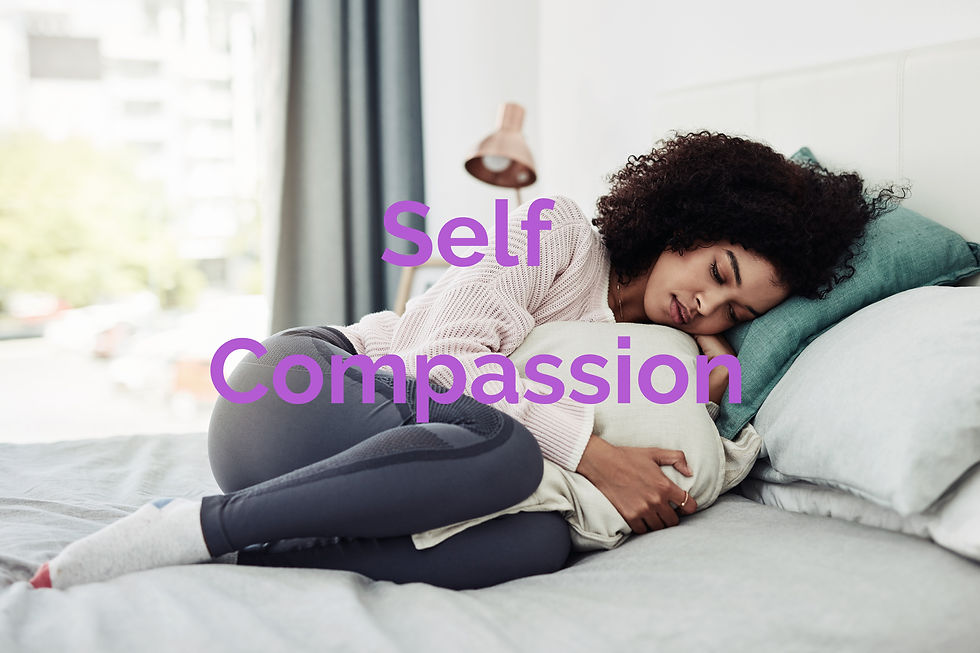
And right now, as we all navigate a landscape of constant change—in healthcare policy, in the environment, in society itself—this practice matters more than ever.
Why self-compassion feels so hard for us
If you’re a physician, educator, or healthcare leader, chances are you’ve been praised for your resilience, your toughness, and your ability to handle whatever comes your way.We internalize a message: Care for everyone else first. Keep your own needs out of it.
Over time, this belief can harden into something dangerous:
We measure our worth by productivity alone.
We criticize ourselves for human mistakes.
We see rest, reflection, or boundaries as luxuries, not necessities.
When the external world feels unpredictable—new regulations, changing patient expectations, environmental crises, workforce shortages—our instinct is often to do more. Work harder. Be stronger.
But that instinct, left unchecked, leads us straight to burnout.
What self-compassion really means (and what it doesn’t)
Many physicians recoil at the term self-compassion, imagining it means giving ourselves a free pass or lowering our standards.
But true self-compassion isn’t about letting ourselves off the hook.It’s about treating ourselves with the same kindness, patience, and realistic perspective we extend to everyone else.
It means acknowledging that you’re human—and that being human isn’t a flaw to overcome. It’s the foundation of the care you give.
It does not mean:
Settling for mediocrity
Making excuses instead of learning
Ignoring responsibility
It does mean:
Responding to mistakes with curiosity instead of shame
Taking breaks when needed so we can continue to serve well
Allowing space for emotion without judgment
When we do this, we don’t become less excellent—we become more sustainable in our excellence.
Self-compassion as an anchor in uncertain times
Healthcare doesn’t exist in a vacuum. Our work is affected daily by broader social and environmental changes:
Natural disasters impacting health systems and patient care
Shifts in policy or reimbursement that change how we practice
Cultural and generational shifts in expectations of leadership
These changes can make us feel unsteady, even powerless.
In those moments, self-compassion can be a quiet anchor.Instead of blaming ourselves for not adapting fast enough, we can say:
“This is difficult, and it makes sense I’m struggling. What support or perspective do I need right now?”
This shift keeps us grounded—so we can show up for our teams and patients with clarity, rather than reactive urgency.
From perfectionism to purposeful excellence
Many high-achieving physicians equate compassion with complacency. But perfectionism is the real threat to our purpose.
Perfectionism says:
“You must never make a mistake.”
“If you’re struggling, hide it.”
“Push through, no matter what it costs.”
Purposeful excellence says:
“You matter too.”
“Your ability to care depends on your own well-being.”
“Sustainable effort is better than heroic burnout.”
Self-compassion helps us make this shift. It invites us to check in:
Are my standards serving my patients and my mission—or just my fear of criticism?
Am I pushing through because it’s truly needed, or because I feel guilty resting?
What would I tell a colleague or mentee in this situation? Can I offer that same grace to myself?
Simple practices for cultivating self-compassion
If the idea of self-compassion still feels foreign, start small. Here are a few evidence-informed, practical strategies—especially useful for busy clinicians and leaders:
✅ Notice and name: When you’re critical of yourself, pause and label it: “I’m judging myself right now.” Naming it creates space to choose a different response.
✅ Mindful check-ins: Take one minute between tasks to breathe, ask, “What do I need?” This can be as simple as a sip of water, a walk, or a moment of quiet.
✅ Reframe mistakes: Instead of, “I shouldn’t have messed that up,” try, “That didn’t go as planned—what can I learn without blaming myself?”
✅ Self-compassion break: Kristin Neff’s three steps:
Acknowledge suffering (“This is really hard.”)
Recognize common humanity (“Others struggle too.”)
Offer kindness (“May I give myself what I need.”)
✅ Boundaries as compassion: Protecting your energy isn’t selfish—it’s what allows you to keep showing up with presence and skill.
Why this matters now
In a time when healthcare workers face growing demands, emotional strain, and environmental uncertainty, self-compassion isn’t an extra. It’s a core skill for resilience and ethical care.
It keeps us connected to:
Our mission and purpose
The people we serve
Our own humanity
And perhaps most importantly: it keeps us from becoming so hardened that we can’t feel joy, empathy, or hope—the very qualities that drew many of us to this work in the first place.
From skepticism to practice
I’ll be honest: years ago, I would have rolled my eyes at advice about self-compassion. It felt impractical. Too soft for the seriousness of medicine.
But what I’ve learned—and what I hope you’ll consider—is this:
Self-compassion doesn’t weaken leadership. It deepens it.
It helps us model authenticity, create psychologically safe teams, and stay aligned with our deepest purpose—even when the world around us keeps shifting.
🌿 If you’d like to explore more ways to protect your energy, lead with purpose, and bring self-compassion into your everyday practice, I offer individualized 1:1 coaching for healthcare professionals and leaders.
Together, we can help you move from exhaustion and self-criticism to balance, clarity, and sustainable excellence—on your terms.
✨ Follow the link to apply and see if coaching with me is the right next step for you:


Comments